Introduction to Astrochemistry:
Astrochemistry is an interdisciplinary field that combines astronomy, chemistry, and physics to study the formation, interaction, and evolution of atoms and molecules in space. It explores how chemical processes occur in extreme environments such as interstellar clouds, protoplanetary disks, comets, planetary atmospheres, and hot cores.
Hot Molecular Cores:
Hot Molecular Cores (HMCs) represent an early stage of high-mass star formation regions (M > 8 M☉), characterized by compact regions less than 0.1 parsec across that develop around massive protostars. Because of their small size and proximity to young stars, these environments become warm, with typical temperatures ranging between 100 and 300 K. This heating comes directly from the radiation of the forming star and is strong enough to evaporate icy mantles from dust grains, injecting molecules into the gas phase.
In addition to being warm, HMCs are also extremely dense, with particle densities reaching values as high as 106–108 cm−3. Such high densities allow molecules to collide more frequently, which in turn drives a rich network of chemical reactions. As a result, hot molecular cores are chemically diverse and are known for their large inventory of complex organic molecules. Among the most common species detected are methanol (CH3OH), methyl cyanide (CH3CN), formamide (NH2CHO), and methyl formate (HCOOCH3), all of which are considered important for the chemistry leading to prebiotic compounds.
The lifetime of a hot molecular core is relatively short, lasting only about 104–105 years before it evolves into an ultracompact H II region, where the intense radiation from the young star ionizes the surrounding hydrogen. This makes HMCs a brief but crucial stage in the process of massive star formation. Because of their warm temperatures, high densities, and chemical richness, they are regarded as natural laboratories for studying the origins of prebiotic chemistry in the universe.
The ultimate goal of astrochemistry is to understand how simple atoms combine to form complex organic molecules, some of which are potential precursors to life.
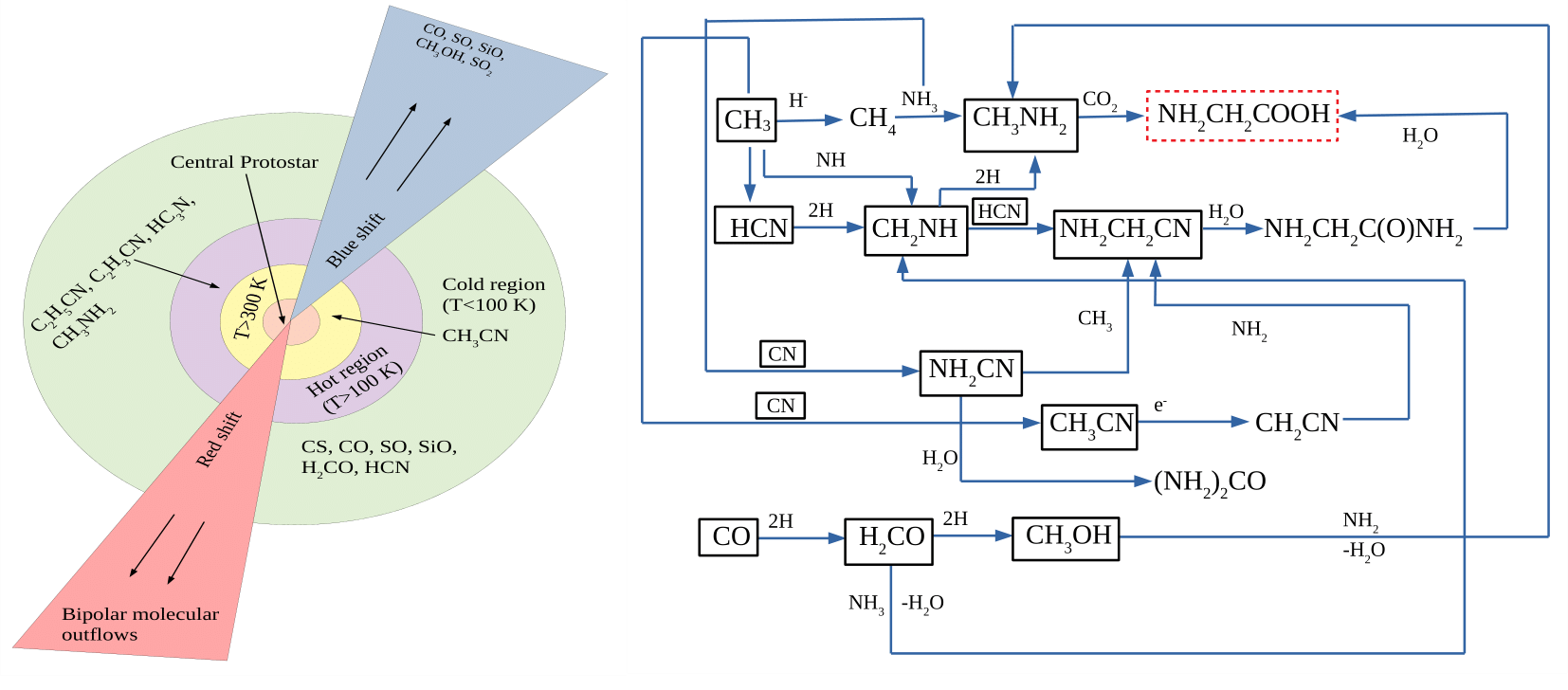
Scope of Astrochemistry:
- Chemical Composition: Identifying simple and complex molecules in the ISM, circumstellar envelopes, and dust/ice chemistry.
- Formation Pathways: Gas-phase reactions, grain-surface chemistry, UV and cosmic-ray induced photochemistry.
- Observations: Radio, millimeter, submillimeter, and infrared astronomy (ALMA, IRAM, JWST, VLA).
- Laboratory Astrochemistry: Experiments simulating interstellar conditions.
- Theory & Modeling: Quantum chemistry and astrochemical networks.
Key Molecular Environments:
- Diffuse Clouds: Simple molecules like H2, CO, OH, CH.
- Dense Clouds: Cold regions rich in NH3, CH3OH, HC3N.
- Hot Cores: Warm regions with complex organics.
- Circumstellar Disks & Comets: Reservoirs of water and organics.
- Planetary Atmospheres: HCN, CO, H2O, CH3 and different hydrocarbons. The atmosphere of Titan contain CH3CN, C2H5CN, C2H3CN and exhibit rich photochemistry.
Methods of Study:
Spectroscopy, radio/millimeter astronomy, infrared observations, laboratory experiments, and computational simulations are key techniques.
Key Discoveries:
- Over 300 interstellar molecules detected (as of 2025).
- Discovery of glycine in comet 67P using Rosetta mission.
- Complex organics like glycolaldehyde (CH2OHCHO) and formamide (NH2CHO) in protostars.
- Discovery of Urea in Sgr B2(N).
Reactions in Astrochemistry:
-
Gas–Phase Ion–Molecule Reactions:
Common in cold interstellar clouds, initiated by cosmic ray ionization.
Example: H3+ + CO → HCO+ + H2 -
Dissociative Recombination:
Ions recombine with electrons and break into neutral fragments.
Example: H3O+ + e− → H2O + H -
Neutral–Neutral Reactions:
Collisions between neutrals; efficient in warm regions (shocks, hot cores).
Example: O + OH → O2 + H -
Radiative Association:
Two species combine and release a photon to stabilize.
Example: C+ + H → CH+ + photon -
Photodissociation & Photoionization:
UV photons break or ionize molecules.
Example: CO + photon → C + O -
Cosmic Ray–Induced Reactions:
Cosmic rays ionize H2, producing secondary UV photons that drive chemistry in dark clouds. -
Grain-Surface Reactions:
Atoms and molecules stick to dust grains and react.
Example: H + H → H2 (on grain surface) -
Ice Chemistry & Photochemistry:
In dense regions, molecules freeze into ice mantles and undergo UV or cosmic-ray processing, forming complex organics like CH3OH and HCOOH.
Why Astrochemistry is Important:
- Star & Planet Formation: Chemistry as a tracer of conditions.
- Origins of Life: Explains water/organic delivery to planets.
- Cosmic Evolution: From hydrogen to complex chemistry.
- Astrobiology: Links molecules in space to prebiotic chemistry.
Future Directions
Next-generation telescopes (JWST, SKA), exoplanet atmospheric studies, quantum simulations of reactions, and interdisciplinary work will drive the field forward.
Conclusion
Astrochemistry is not just about molecules in space, it is a story of cosmic evolution. From simple hydrogen clouds to planets capable of hosting life, astrochemistry traces the steps of chemical complexity in the universe. Its importance lies in unraveling the ultimate question: How did the building blocks of life originate and spread across the cosmos?
Links of tutorials
- Basic principles of Astrochemistry by Professor Ewine F. van Dishoeck.
- Tutorials of Astrochemistry and Interstellar Medium.
- The Astrochemistry of Massive Young Stellar Objects: PhD Thesis by Dr. Naomi Asabre Frimpong.
- A detail talk of Astrochemistry by Professor Masatoshi Oishi.
- A detail talk of Astrochemistry in ISM by Professor Valentine Wakelam.
- A detail talk of chemical processes in space histories and current understanding by Professor Eric Herbst.
- Tutorial on spectral analysis using CASSIS.
- Tutorial on spectral analysis using MADCUBA.
- Estimation of column density of molecular lines with some examples by Mangum & Shirley.
- Review paper of Astrochemistry During the Formation of Stars by Jørgensen, J. K., Belloche, A., and Garrod, R. T.
- Review paper of Complex Organic Interstellar Molecules by Eric Herbst & Ewine F. van Dishoeck.
- Review paper of chemical evolution of star-forming regions by Ewine F. van Dishoeck & Geoffrey A. Blake.